Zombie love story Sora
To make a zombie love story Sora clip, skip OpenAI Sora — the web and app experiences were discontinued on April 26, 2026 and the Sora API on September 24, 2026 — and run the four-beat plan below in another image-to-video tool or our maker.
Sora is discontinued — the beat plan still holds
OpenAI’s Sora Help page is the status source: Sora web and app experiences were discontinued on April 26, 2026. The Sora API was discontinued on September 24, 2026. Content export was offered through sora.chatgpt.com/sunset. Purchased ChatGPT/Sora credits can still be used for Codex, per that help copy. Those leftover credits are not a video path. The developers video-generation guide is retained for historical reference and states: “The Sora 2 models and Videos API were shut down on September 24, 2026 and are no longer available. No one-to-one replacement API is available.”
When the product was live, the model split was sora-2 for speed and flexibility, and sora-2-pro for higher quality, including 1080p exports at 1920×1080 or 1080×1920. Both models supported 16-second and 20-second generations. Historical docs also list shorter supported seconds values: 4, 8, 12, 16, and 20. Capabilities included create from prompt, image reference, character references, extensions, and edits. This page uses those names only as history. It does not invent a current per-second price, a live endpoint, or a replacement model from OpenAI.
People still type “zombie love story Sora” because they saw the trend and remember Sora 2 as the generator they wanted. The clip they want is our four-beat shape: a ruined world, a survivor who refuses to fire, an embrace, and a warm memory of the couple. Our finished edit is about twelve seconds, vertical 9:16. That is our editorial target, not a Sora preset. A historical 12-second Sora 2 job was only a duration option. It was not a locked four-beat template. Generate the cold embrace and the warm embrace as separate clips. Do not ask one take to morph infected skin into a healthy memory.
Sora 2 was announced as a video model on OpenAI’s Sora 2 launch page; the consumer product and API were later discontinued on the dates above. Zombie Love Story has no partnership with OpenAI or Sora. If you exported files from the sunset page, cut those takes with the beat map below. If you never used Sora, take the same map into another image-to-video tool or our maker.
Prepare the couple and the matching stills
Use adults who agreed to this fictional treatment. Pick readable eyes, jaw, and hair at a similar camera height. A is the survivor. B is the infected beloved. The photo guide covers the rest. No celebrities, strangers, or minors.
Make four stills before any video job. One vertical frame each: cold two-shot, refusal, cold embrace, warm embrace. A on the left, B on the right. Pale tired skin on the beloved in the cold world, no wounds. The warm still is a new lighting setup on wheat-dusk, not a color grade of the hug. Two portraits name the people. They are not an image-reference frame. Historical Sora 2 image reference needed a composed still of the beat already. Character references, when that control existed, were extra named inputs. That is a historical product label, not a portrait-match promise, and it is gone with the API.
If you exported old Sora files from the sunset page, pull a still from the last readable cold-hug frame and a still from a healthy hold, then treat those as the match-cut pair. Compare them before you animate anything new. If a face sits in the upper third on one still and in the center on the other, fix the still. Match the camera distance and the shoulder line, then continue a pose the frame already shows.
Map each trend beat to historical Sora 2 capabilities vs our maker
Capability names and durations are from OpenAI’s historical Sora 2 developers guide, fetched 2026-11-09. Timing, trim points, and the maker column are ours. Sora 2 is not available now.
| Final edit beat | Historical Sora 2 (when live) | Our maker |
|---|---|---|
| 0–3 seconds: ruined world | Image-reference create on sora-2 or sora-2-pro from the cold two-shot. Prefer a 4- or 8-second generation, then trim. On sora-2-pro, 1080×1920 was the vertical 1080p export. | Beat one of a locked 12-second 9:16 four-beat clip. You pick a world. There is no prompt field. |
| 3–5 seconds: refusal | A separate image-reference job from the refusal still. A historical 12-second generation could cover beats one and two in the same cold world, then you trimmed. Keep the job on ruined light. Reject muzzle flash. | Beat two: a raised gun that never fires. The refusal is locked. No gore. |
| 5–9 seconds: embrace | New image-reference create from the cold embrace still. Extensions could lengthen breathing in this ruined world. Edits were for small changes in the same take. Do not extend this clip into the memory. | Beat three: the AI zombie hug. Arms close. Both characters on camera. |
| 9–12 seconds: warm memory | A new image-reference create from the warm embrace still. Hard-cut in an editor. Do not use a 16- or 20-second generation, character references, or an edit to morph infected skin into healthy skin inside one file. | Beat four: the warm-memory match cut is the designed last beat. |
A beat-by-beat shot plan you can actually edit
Beat one is a cracked wasteland road at blue hour. The two adults already face each other in a medium two-shot. A stripped sedan sits behind A; an empty horizon sits behind B. Coat hems move in a light wind. Skip running, a circling camera, and a third figure. Historically, a 4-second sora-2 or sora-2-pro image-reference create from the cold two-shot was enough; an 8-second take only added handles. Create-from-prompt was weaker here because you could not pin the incoming frame. Trim to about three seconds. Today, any image-to-video tool that accepts a first frame can hold this blocking.
Beat two is the choice. The unfired prop starts low, barrel toward the gravel, away from both faces. Ask for a pause, eye contact, and a lowering hand. Reject a raise-and-aim, a muzzle flash, or a threatening follow-through. If the tool blocks a weapon, use an empty hand that opens and drops. Do not bypass a safety block. A historical 12-second Sora 2 generation could cover beats one and two in the same cold world, then you would trim. Keep that job on ruined light. Do not sneak the memory into the second half of a 12-, 16-, or 20-second take.
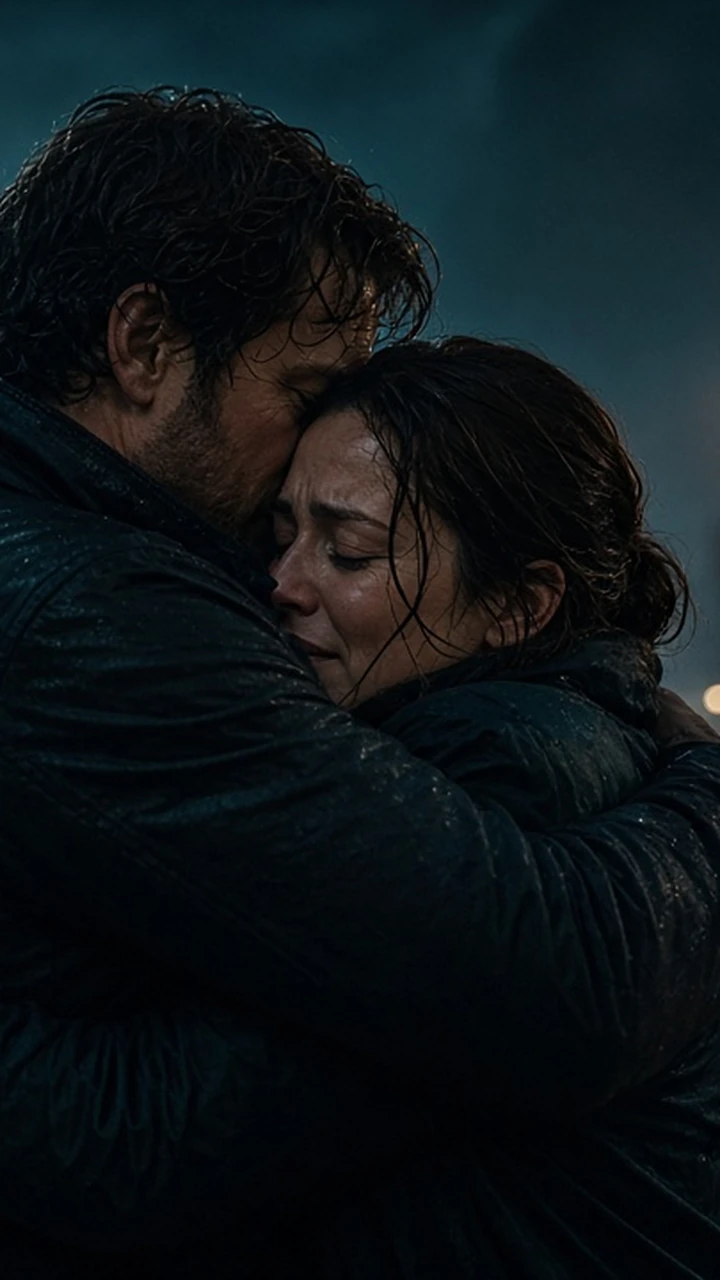
Beat three closes the distance. Start close enough that one step becomes a hug. B’s hand meets A’s upper back. Faces stay partly visible until contact, so the later cut has something to match. Historically this was a new image-reference create from the cold embrace still, not an edit that heals the beloved. Extensions, when they existed, could lengthen breathing in this same ruined world. They were not a license to change the lighting or the skin. Inspect hands and elbows. Trim to about four seconds of contact.
Beat four reads that pose as a memory. Hard-cut in an editor to healthy skin and wheat-dusk light. Keep the head tilt and the shoulder line. Generate the hold from the warm still as its own clip — historically a separate sora-2 or sora-2-pro image-reference job, today a separate take in whatever tool you still have. Trim to about three seconds. Do not use a 16- or 20-second historical generation, or any current tool’s long mode, to morph infected skin into the memory inside one file. Align the heads, then the horizon, then the color.
Original prompts for stills and motion
These prompts are ours. When Sora 2 was live they would have sat on an image-reference create job, not on two portraits. Today paste them into another image-to-video tool that still accepts a first frame. They are not for our maker, which has no freeform prompt field.
Cold two-shot still: “Vertical 9:16. Wide-medium still on a cracked asphalt road at blue hour. Adult survivor left, worn dark coat, weight on the back foot. Adult beloved right, pallid infected skin, eyes open and tired, no wounds. They already face each other. A stripped sedan sits behind the survivor as scale. Dust in the air. No crowd, no titles, no blood.”
Refusal still: “Keep the cracked road, the sedan, and the left-right order. The survivor grips an unfired prop at hip height, muzzle toward the gravel, not toward the beloved. Both look at each other. No flash, no smoke, no wound.” Motion prompt: “Static camera, 9:16. Hold two beats of eye contact. The survivor’s shoulders drop. The unfired prop lowers until the muzzle meets the gravel. Coats move in wind. No step forward, no discharge, no camera whip.”
Cold embrace still: “Same road, same coats. The pair has closed to a quiet hug: survivor’s chin near the beloved’s temple, both faces still readable at the cheek, hands high on the back. Pallid skin on the beloved only. No gore, no extra arms.” Motion prompt: “Start on this hug. One half-step closer, then settle. Ribcages move with breath. Hands stay on upper back. Do not orbit. Do not change the skin. Do not add people.”
Warm memory still: “Vertical 9:16 memory still at wheat dusk. Both adults healthy, gold light, the hug already formed. Copy the head tilt, the shoulder slope, the coat outline, and the lens distance from the cold hug. No caption, no sparkle overlay.” Motion prompt: “Hold this healthy dusk hug. Breath only. Fabric stirs. No walk, no spin, no dissolve, no text.”
Cold-world sequence note, for tools that accept ordered stills: load the two-shot, the refusal, and the settled hug only. Prompt: “9:16. Cold world only. Play the three stills in order: stand-off, lowered prop, settled hug. Stay on the cracked road at blue hour. Small motion between poses. No healing, no gunshot, no fourth person.” Run the warm still as a separate job.
Historical Sora DIY versus the Zombie Love Story maker flow
Zombie Love Story has no partnership with OpenAI or Sora, and this maker is not a Sora control panel.
| Decision | Historical Sora DIY (when live) | Our maker flow |
|---|---|---|
| Inputs | Prepare composed scene stills, then run image-reference create on sora-2 or sora-2-pro. Create from prompt was the no-still fallback. Character references were extra named inputs, not two portraits dropped in as a first frame. | Two photos as creative reference, with A and B roles; B can be a pet. |
| Story control | You chose sora-2 or sora-2-pro, a supported duration (4, 8, 12, 16, or 20 seconds), and 1080×1920 on sora-2-pro for vertical 1080p. Extensions and edits stayed inside one take. | Four locked beats; choose a world instead of writing a prompt. |
| Match cut | You generated the cold and warm embraces separately and aligned them in an editor. One Sora clip should not morph infected skin into the memory, even on a 16- or 20-second job. | The designed fourth beat is the warm-memory match cut. |
| Output expectation | Inspect takes, then trim 4- or 8-second clips into the twelve-second story. The Sora web/app and API no longer produce new files. Old files could be pulled from the sunset export page. | Designed SKU: 12 seconds, 9:16, 720p; the preview uses sample stills. |
| Checkout and scale | Sora consumer and API are discontinued. No one-to-one replacement API is available. Purchased ChatGPT/Sora credits can still be used for Codex, not for new Sora video. | Checkout is a demo and does not charge. Live paid generation is not connected for mass production. |
Lengths, honest limits, and what to use instead
Twelve seconds is our edit, not a Sora preset. Historical Sora 2 durations included 4, 8, 12, 16, and 20 seconds. Prefer 4- or 8-second takes for a single beat, then trim to about 3, 2, 4, and 3 seconds. A historical 12-second job can span two cold beats in one world. Generate the warm memory separately.
We do not quote a current Sora price. The consumer product and the Videos API are gone, and OpenAI says there is no one-to-one replacement API. sora-2-pro’s 1080p vertical export was 1080×1920 when it was live. That is history, not a file you can order from OpenAI today.
Use another image-to-video tool that still accepts a first frame. On this site the Pika, Luma, Runway, and Kling guides carry live-tool shot maps. Or walk our maker: two photos, one world, four locked beats. Our maker has no freeform prompt field. The preview shows sample stills. Checkout is a demo and does not charge. Live paid generation is not connected for mass production.
If this workflow is the wrong fit
Compare Midjourney, Hunyuan, HappyHorse, Seedance, Wan, Vidu, Hailuo, PixVerse, Veo, Sora, Kling, Runway, Luma, and Pika through our tool guides. Check each workflow’s documented inputs and limits, or walk /create to inspect our preview. Checkout is a demo and does not charge; live paid generation is not connected for mass production. Compare Grok Imagine in the guide below. Compare Firefly in the guide below. Compare Higgsfield in the guide below. Compare Marey, LTX, Leonardo and Nova Reel in the guides below.
Final review before sharing
- Watch without sound. The viewer should understand recognition, refusal, embrace, and memory from the pictures alone.
- Compare the frame before and after the match cut. Keep the heads and shoulders aligned; remove a distracting flash or unwanted dissolve.
- Inspect the prop, hands, and faces at full size. Reject firing, gore, swapped identities, or a broken embrace rather than hiding the failure under captions.
- Keep captions clear of the faces and label the result as AI-made fiction. Use audio only when you have the rights, and ask the subjects before publishing.
- Save the source stills, chosen takes, and final timeline together so a revised ending does not require rebuilding every beat.
- Zombie love story Marey
- Zombie love story Nova Reel
- Zombie love story Leonardo
- Zombie love story LTX
- Zombie love story Higgsfield
- Zombie love story Firefly
- Zombie love story Grok Imagine
- Zombie love story Midjourney
- Zombie love story Seedance
- Zombie love story HappyHorse
- Zombie love story Hunyuan
- Zombie love story Wan
- Zombie love story Vidu
- Walk the maker
- Zombie love story prompt
- Edit with CapCut
- Plan the match cut
- Choose reference photos
- Zombie love story Pika
- Zombie love story Luma
- Zombie love story Runway
- Zombie love story Kling
- Zombie love story Veo
- Zombie love story Hailuo
- Zombie love story PixVerse
Questions
How do I make the zombie love story trend with Sora now?
You do not. Sora web and app experiences were discontinued on April 26, 2026 and the Sora API on September 24, 2026. Use the four-beat plan on this page in another image-to-video tool, or walk our maker.
What happened to Sora 2 and the Videos API?
OpenAI shut down the Sora 2 models and Videos API on September 24, 2026. The developers guide is retained for historical reference and says no one-to-one replacement API is available. Content export was offered via sora.chatgpt.com/sunset. Purchased ChatGPT/Sora credits can still be used for Codex.
Did Sora 2 generate exactly twelve seconds at 9:16?
Twelve seconds is our edit target. Historical Sora 2 supported 4, 8, 12, 16, and 20 seconds. sora-2-pro 1080p exports were 1920×1080 or 1080×1920. 1080×1920 is vertical; it was not our locked four-beat template.
Should one Sora clip morph the infected hug into the memory?
No. Generate the cold and warm embraces as separate clips and hard-cut. Do not use a 16- or 20-second take, an extension, or an edit to heal infected skin mid-clip.
Can I paste these prompts into your maker?
No. Our maker has no freeform prompt field. It uses two photos as creative reference, a world choice, and four locked beats. The preview shows sample stills; checkout is a demo and does not charge.
Is Zombie Love Story affiliated with OpenAI or Sora?
No. This is an independent guide with our own shot plan and prompt examples. The maker is not a Sora integration, and live paid generation is not connected for mass production.
What should I use instead of Sora?
Another image-to-video tool that still accepts a first frame — see our Pika, Luma, Runway, and Kling guides — or walk the Zombie Love Story maker.